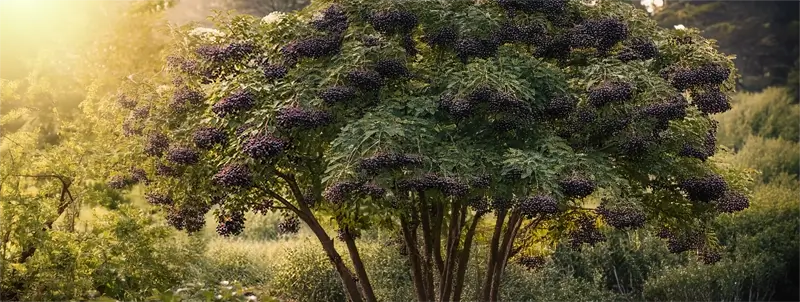
This plant is traditionally used as a medicinal plant by many native peoples and herbalists alike. Stem bark, leaves, flowers, fruits, root extracts are used to treat bronchitis, cough, upper respiratory cold infections, and fever. Studies show that elderberry is effective for treating Influenza. In Poland and the Ukraine elderberry flowers are sold in drugstores for relief of congestion, specifically as an expectorant to relieve dry cough and make it productive. The dried flowers are brewed into tea and used as a remedy for inflammation caused by colds and fever.
Christian legend states that Judas Iscariot hanged himself from an Elder tree and that the cross on which Jesus was hung was made of elder. Traditionally, elder was used to ward off evil influences, witches, spirits, and death in England and Russia. Knots made from elder twigs were sometimes carried as charms to protect from rheumatism in England. The Serbs considered elder to be good luck.
Some people take elderberry by mouth for the common cold, "the flu" (influenza), and H1N1 "swine" flu. It is also taken by mouth for HIV/AIDS and boosting the immune system. Elderberry is also taken by mouth for sinus pain, back and leg pain (sciatica), nerve pain (neuralgia), and chronic fatigue syndrome (CFS). Some people also take elderberry by mouth for hay fever (allergic rhinitis), cancer, as a laxative for constipation, to increase urine flow, and to cause sweating. It is also used for heart disease, high cholesterol, headache, toothache, and weight loss. Some people apply elderberry to the inside the mouth for gum inflammation.